
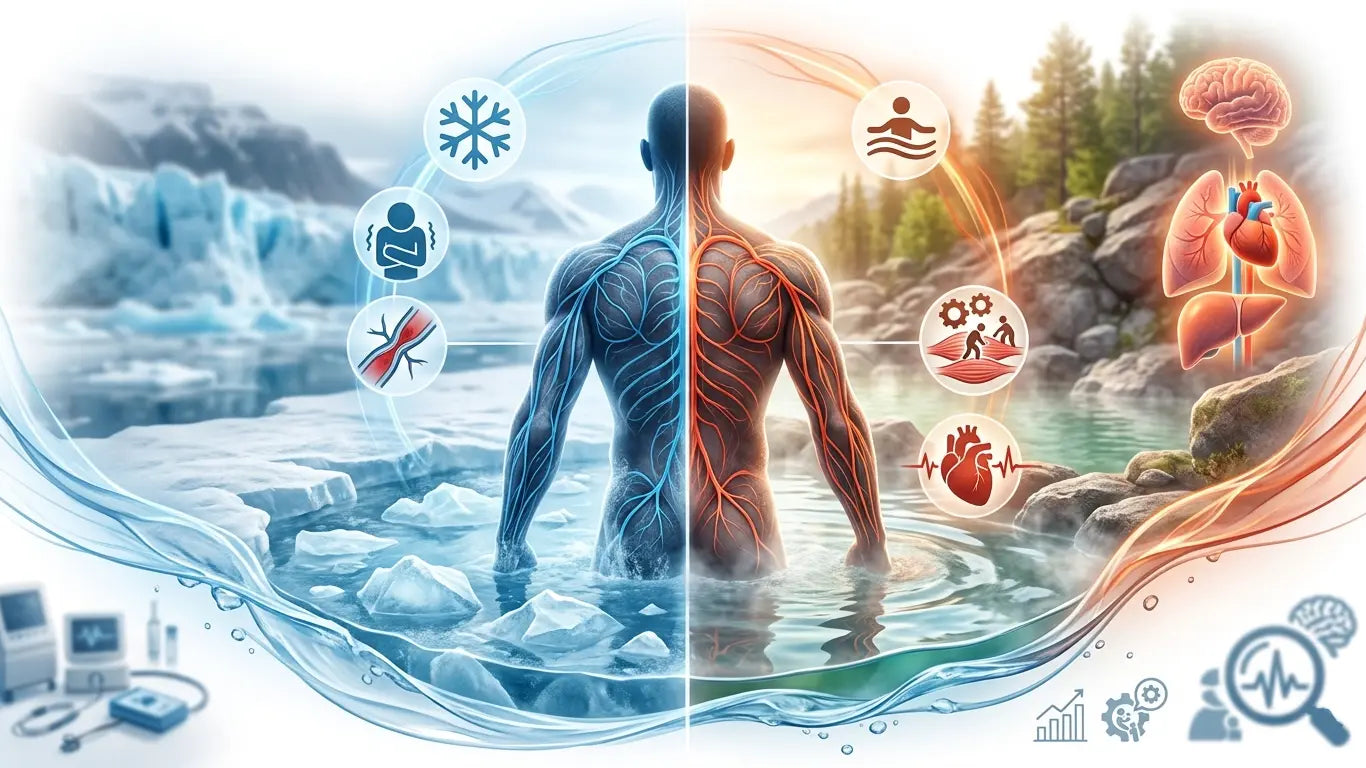
Every few months, a new video goes viral — someone gasping as they lower themselves into a tub of ice water, claiming it changed their life. Celebrities swear by it. Athletes have done it for decades. And now it's showing up in wellness routines far beyond the gym.
But here's the honest question: does the cold actually do anything useful, or is this just another wellness trend dressed up in science?
The answer is more nuanced than most articles let on. Ice baths do have real, documented benefits — but they're not universal, not risk-free, and not the right tool for every situation. This article cuts through the noise and looks at what cold water immersion actually does, who it helps, and where the evidence gets shaky.

What's Actually Happening in Your Body
Most articles stop at "reduces inflammation." That's true, but it's only part of the picture.
The Cold Shock Response
The moment cold water hits your skin, your body triggers a cascade of reactions. Heart rate spikes. Breathing quickens. Blood vessels near the skin constrict, pushing blood toward your core and vital organs. Stress hormones — adrenaline and cortisol — flood your system.
This isn't damage. It's adaptation. And over time, repeated exposure trains your body to handle that stress more efficiently.
The Vagus Nerve Connection
One of the least-discussed effects of cold immersion is its impact on the vagus nerve — the main highway of your parasympathetic nervous system. Cold exposure stimulates vagal tone, which improves heart rate variability (HRV). Higher HRV is associated with better stress resilience, faster recovery, and improved cardiovascular health.
This is arguably more significant than the dopamine boost that gets all the attention.
Mitochondria and Cellular Adaptation
Beyond brown fat activation (which gets plenty of coverage elsewhere), regular cold exposure appears to stimulate mitochondrial biogenesis — the creation of new mitochondria in cells. More mitochondria means more efficient energy production. This is the same adaptation triggered by endurance exercise, which is why some researchers are exploring cold exposure as a complementary tool for metabolic health.
The Sleep Angle
Your core body temperature needs to drop to initiate deep sleep. An ice bath in the late afternoon or early evening accelerates that drop, potentially improving sleep onset and sleep quality. Timing matters here — a cold plunge right before bed can have the opposite effect by temporarily spiking alertness.

Do Ice Baths Kill Muscle Gains?
This is where the science gets genuinely messy, and most articles either ignore it or pick a side without explaining why.
The short version: it depends on your training goal and your timing.
The mTOR Problem
After resistance training, your muscles repair and grow through a process partly driven by the mTOR signaling pathway. Inflammation is actually a necessary part of this process — it's a signal that triggers adaptation. Cold water immersion suppresses that inflammatory response.
For someone training primarily for hypertrophy (muscle size and strength), taking an ice bath immediately after lifting may blunt the very signal that drives muscle growth.
Endurance Athletes: A Different Story
For endurance athletes — runners, cyclists, triathletes — the calculus flips. Their priority is reducing soreness and recovering fast enough to train again tomorrow. The anti-inflammatory effect of cold immersion is exactly what they need.
| Training Goal | Ice Bath Timing | Recommendation |
|---|---|---|
| Strength / Hypertrophy | Immediately post-training | ❌ Avoid — may blunt gains |
| Endurance / Cardio | Within 30 min post-training | ✅ Beneficial for recovery |
| Combat / Contact Sports | Post-competition | ✅ Useful for systemic inflammation |
| General Wellness | Morning, separate from training | ✅ Fine for most people |
The practical takeaway: if you lift weights for muscle growth, wait at least 4–6 hours before an ice bath. If you're an endurance athlete, the sooner after training, the better.
It's Not One-Size-Fits-All
Women and Hormonal Cycles
This is almost entirely absent from mainstream ice bath content. Cold tolerance and physiological response to cold stress vary across the menstrual cycle. During the luteal phase (the two weeks before menstruation), core body temperature is naturally elevated and the body's stress response is heightened. Cold exposure during this phase may feel more intense and recovery may be slower. During menstruation itself, cold immersion can worsen cramping and discomfort for some women.
This doesn't mean women shouldn't use ice baths — it means the protocol should be adjusted based on cycle phase.
Age Considerations
For people over 40, the cardiovascular demand of cold immersion deserves more attention. The sudden blood pressure spike triggered by cold shock is manageable for healthy individuals but can be significant for those with hypertension or arterial stiffness. Starting with higher water temperatures (around 15–18°C / 59–64°F) and shorter durations is a sensible approach.
Training Type Matters
A marathon runner and a powerlifter have almost opposite needs from cold therapy. The former benefits from rapid inflammation control; the latter may be actively undermining their training by using ice baths too frequently. Knowing which category you fall into changes how — and whether — you should use cold immersion at all.
How Much Should You Trust the Research?
Here's something most ice bath articles won't tell you: the research base is thinner than the hype suggests.
Common methodological problems in ice bath studies:
- Most studies have fewer than 30 participants
- It's nearly impossible to blind participants to whether they received cold or warm water treatment — meaning placebo effects are hard to rule out
- Study durations are often short (days or weeks), making long-term conclusions unreliable
- "Ice bath" protocols vary wildly between studies — water temperature, immersion depth, and duration differ enough to make comparisons difficult
This doesn't mean the benefits aren't real. It means the magnitude of those benefits is uncertain, and individual responses vary more than headlines suggest.
A practical filter for evaluating health claims:
- Does the study have a control group?
- Was it conducted on people similar to you (age, fitness level, health status)?
- Has it been replicated by independent researchers?
- Is the effect size meaningful, or just statistically significant?

What Cold Cultures Can Teach Us
The Nordic tradition of avantouinti — swimming in holes cut through frozen lake ice — has been practiced in Finland and Norway for centuries. What's interesting isn't just the cold exposure itself, but the social context around it. These practices are communal, ritualized, and tied to sauna culture (alternating heat and cold).
Finnish population data consistently shows strong cardiovascular health and mental wellbeing metrics, though isolating cold exposure as the cause is impossible — diet, lifestyle, and social cohesion all play roles.
Japan's Misogi practice — standing under cold waterfalls as a form of spiritual purification — has been reframed in modern wellness circles as a mental resilience tool. The psychological dimension here is real: deliberately choosing discomfort, and completing it, builds a specific kind of confidence that carries over into other areas of life.
The lesson from both traditions isn't that cold water is magic. It's that consistency, community, and intentionality amplify whatever physiological benefits exist.
Ice Baths vs Other Recovery Methods
| Recovery Method | Evidence Strength | Best Use Case | Drawbacks |
|---|---|---|---|
| Active Recovery (light movement) | ⭐⭐⭐⭐⭐ | Daily training | Requires effort post-workout |
| Compression Garments | ⭐⭐⭐⭐ | Endurance events | Cost, comfort |
| Ice Bath / Cold Immersion | ⭐⭐⭐ | High-intensity post-competition | May blunt strength gains |
| NSAIDs (e.g., ibuprofen) | ⭐⭐⭐ | Acute injury | GI side effects, overuse risk |
| Contrast Therapy (hot/cold) | ⭐⭐⭐ | Comprehensive recovery | Requires both facilities |
| Massage | ⭐⭐⭐⭐ | Muscle tension, soreness | Cost, accessibility |
Ice baths sit in the middle of the pack — genuinely useful in the right context, but not the superior option across the board. Active recovery has stronger and more consistent evidence for most everyday training scenarios.
Cold Bath vs Hot Bath
Hot baths have their place. But there are specific situations where cold water has a clear edge.
1. Nervous System Activation
Cold water activates the sympathetic nervous system — the "go" system. The result is a rapid increase in alertness, focus, and energy that can last for hours. Hot water does the opposite: it activates the parasympathetic system, promoting relaxation and drowsiness.
If you need to be sharp and productive, cold wins. If you need to wind down, hot wins. They're tools for different jobs.
2. Acute Inflammation Control
After intense exercise, cold water's vasoconstrictive effect reduces localized swelling and numbs pain receptors more effectively than heat. Hot water can actually increase inflammation in the acute phase by dilating blood vessels and increasing blood flow to already-inflamed tissue.
Rule of thumb: cold for acute (0–72 hours post-injury or post-exercise), heat for chronic (ongoing muscle tightness, stiffness).
3. Immune System Stimulation
Regular cold water exposure has been associated with increased white blood cell production, which may contribute to a more responsive immune system. Hot baths don't appear to produce the same immune-stimulating effect.
4. Skin Barrier Integrity
Cold water tightens pores and stimulates sebum production, which supports the skin's natural barrier. Hot water — especially at high temperatures — strips natural oils and can compromise the skin barrier over time, leading to dryness and irritation.
5. Cardiovascular Training Effect
The repeated cycle of vasoconstriction (cold) and vasodilation (rewarming) functions like a workout for your blood vessels, potentially improving vascular elasticity over time. Hot baths cause vasodilation but don't produce the same training stimulus.

Who Actually Benefits from Ice Baths?
Not everyone gets the same return from cold immersion. Here's an honest breakdown of who tends to benefit most.
Endurance Athletes
The strongest evidence for ice baths sits here. Runners, cyclists, and triathletes dealing with high training volumes and frequent competition benefit from faster inflammation control and reduced delayed-onset muscle soreness (DOMS). The ability to recover faster between sessions has real performance implications.
Combat and Contact Sport Athletes
Full-contact sports produce systemic inflammation across multiple muscle groups simultaneously. Ice baths address this more efficiently than localized ice packs or compression. Post-competition cold immersion is standard practice in many professional combat sports for this reason.
People Who Need a Morning Cognitive Reset
The sympathetic activation from cold immersion produces a reliable alertness boost. For people who struggle with morning brain fog, or who want to reduce caffeine dependence, a short cold plunge can serve as an effective substitute. The effect is immediate and doesn't carry the crash associated with stimulants.
Those Building Stress Resilience
Deliberately entering cold water and staying calm is a form of stress inoculation. The psychological mechanism is straightforward: you practice tolerating discomfort in a controlled setting, and that tolerance generalizes. People who use cold exposure as a mental training tool — rather than purely a physical one — often report improvements in how they handle stress in other areas of life.
People with Frequent Colds or Low Immune Resilience
Regular cold water exposure may support immune function through increased white blood cell activity. This isn't a cure or a guarantee, but for generally healthy people who get sick frequently, it's a low-cost intervention worth trying consistently over several months.
Skin Health Conscious Individuals
For people dealing with oily skin, enlarged pores, or sensitivity to hot water, cold water immersion offers a gentler alternative that supports rather than disrupts the skin barrier.

Who should be cautious or avoid ice baths:
| Group | Reason |
|---|---|
| ❌ Heart disease / hypertension | Blood pressure spike risk |
| ❌ Raynaud's syndrome | Extreme vasospasm risk |
| ❌ Pregnant women | Thermal stress to fetus |
| ⚠️ Strength/hypertrophy athletes | May blunt muscle protein synthesis |
| ⚠️ Women during menstruation | May worsen cramping |
| ⚠️ Adults 60+ | Higher cardiovascular demand; start slow |
Summary
Ice baths have real, physiologically grounded benefits. They're not placebo, and they're not just for elite athletes. But the evidence is more specific than the wellness industry tends to admit.
Here's the honest summary:
| Benefit | Strength of Evidence | Best For |
|---|---|---|
| Reduced muscle soreness & faster recovery | Strong | Endurance & contact sport athletes |
| Alertness & cognitive activation | Moderate–Strong | Morning routines, focus work |
| Immune support | Moderate | Generally healthy people, consistent use |
| Cardiovascular training effect | Moderate | Healthy adults under 60 |
| Skin barrier support | Moderate | Cold-sensitive or oily skin types |
| Stress resilience & mental toughness | Moderate | Anyone using it as deliberate practice |
| Sleep quality improvement | Moderate | When timed correctly (afternoon/early evening) |
| Digestive support | Weak | Limited evidence; anecdotal |
The conditions that matter:
- Timing relative to training changes the outcome significantly
- Individual factors (age, sex, health status, training type) determine whether benefits apply to you
- Consistency over weeks and months matters more than any single session
- The research base, while promising, has real limitations — don't treat any single study as definitive
If you're a healthy adult with no cardiovascular conditions, ice baths are a low-risk, potentially high-reward tool — especially if your goals involve athletic recovery, mental sharpness, or stress resilience.
Share:
What Can We Gain From Ice Bath?
How Long Should You Stay in an Ice Bath? (It Depends on You)